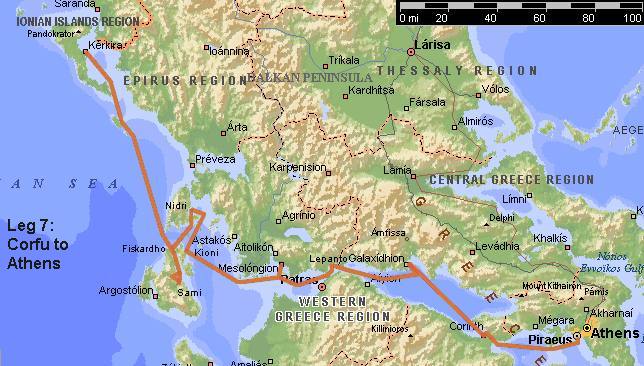
By mid-morning I was sitting on the terrace of the sea-front house, a little concerned as the wind was getting up and I didn't have a proper forecast. A guy from the diving school across the bay drove his rib in and shouted that if I was the owner of the boat in front to move it into the port immediately. Seathrift was sheltered behind the reef, but Second Wind was exposed to the big swell that would soon develop. John had disappeared into Corfu to see about his house, so I took David his brother and his friend Peter with me, neither of whom were experienced but were younger and strong, and went back to the boat. Already the surf had increased so that my dinghy was full of water and the wind had increased so that I couldn't pull up the anchor without engine assistance.
When we got into the small port of Palaokastritsa, the one gap on the quay that I had seen earlier was already filled, and there was no option but to join the growing rank of boats outside the fishing boats. I anchored and reversed but nobody on the quay wanted to help with the mooring lines until I called for help. But one young lad came, but steered the boat away from the fishing boat I was closest to so I was left with the anchor trailing across several other lines.
David was concerned about Seathrift and headed back while I sorted things out. When I got back they were bailing out the other dinghy which had been moored several yards out but was overwhelmed by the growing surf. I waded in to help, getting my wallet soaked and losing my keys which floated out of my pocket. But there was no time to waste. David and I rowed out to the boat, leaving Peter who wasn't a strong swimmer. Once on the boat it was clear that it was safe for the time being. I showed David how to take bearings for position and we discussed taking her into harbour. But the wind didn't grow worse and eventually calmed a bit and the bearings didn't change, so eventually we swam ashore and waited for John to return.
I went back to the harbour and had a meal in the sea front restaurant. Seathrift arrived a little later and achored in the bay. Some American girls on the quay were taking photographs of themselves in front of the sailing boats and when I talked to them they asked if they could come sailing and said my Second Wind was a beautiful boat. Unfortunately I had to tell them what the fishermen had told me, that the storms would continue for a couple of days and they wouldn't be able to come out before Monday when I hoped to sail round the north of the island. But it will be nice to have a crew again, if they come!
Saturday/Sunday September 9/10
The weather and forecasts were bad. Strong winds throughout the Greek seas due to a stationary depression in the boot of Italy. So I explored Palaokastritsa, which is a beautiful area. On Sunday I went up to the monastery, which was overwhelmed by tourists, and climbed the hill up to Lakonos. I swam in a free swimming pool in one of the hotels (evidently a right in Greece) and bought a blue rug for the boat for only 1,400Dr (£3) with roof scenes that remind me of my friend Barbara who did similar designs for Spear.
Monday September 11
At last the forecast had nothing worse than rain and I finally set out at about 10.20 a little ahead of Seathrift (the US lasses hadn't turned turned up). There was still quite a swell and an easterly 10-13 knot wind in the bay, so I put up the sail However it didn't hold round the head, and for most of the trip up the west coast of Corfu there was little wind.
There are several tricky channels to negotiate: one has a concealed rock 1m below the surface and another goes very close to the coast of Albania. So I'd set up the route very carefully on the GPS with 14 waypoints and stuck to it very closely. I practised taking bearings off the headlands and my plots on the chart were accurate.
As I rounded the north of the island the wind followed me - mostly a direct headwind - and it started to rain steadily. I put on full oilies and was grateful for the autohelm as I was able to stay below most of the time and have a hot lunch. But it only takes 10-15 minutes from sighting a sailing boat travelling in the other direction to passing it a few metres apart, so keeping a lookout is important.
The wind shifted to NNW and eventually to W and when I gybed to turn right at Nisos Peristerai lighthouse, it came from SW. By the time I got properly into the narrow straight between Corfu and Albania it died altogether. So at least I had no difficulty maintaining an exact course between the military exclusion one close to the island and the boundary line with Albania. There was no sign of life on the Albanian coast.
I reached Gouvia marina and for once beat Seathrift with her more powerful engine. It was a thoroughly unpleasant day, but at least there was a civilised marina to dock into, with plenty of English boats.
The next thing I had to face was meeting my disabled friend Guy at the airport at 3.30 in the morning. I was exhausted by the day and went to bed at around 9 having acquired the number of a taxi firm. At around midnight my mobile rang. It was Guy, who had been turned off the plane by the Monarch aircrew after he had requested help to get to the toilet!
I expressed my outrage at this turn of events, but there was little I could do. I called his hostel and the woman on duty was equally upset. But Scope provided no 24 hour legal support and it looks as if he won't make it this time round.
Tuesday/Wednesday September 12/13
Days in port in Gouvia doing maintenance. There is a great chandlery near the port called Force 5. It's a better name than the Force 4 chain in England and I was able to get fuel filters and a number of minor items. I had a guy from the port come round to advise about my masthead light and he suggested that either I wait to the end of the season and take the mast down or take the boat to the small cut behind the fort in Kerkira where there is a high bridge which I could lean over and reach the top of the mast! I cycled into town to check this out and enjoyed the trip round the fort but decided against fixing the light now. It would take at least two people and was too risky. But it is a lovely town, with old Venetian buildings and a cheerful bustle.
John and Sue were having great difficulties with their house purchase and they came over for farewell drinks on Wednesday evening. It was sad to say farewell after 600 miles sailing together, but I had fixed up to meet my friends Donna and Laura in Cefallonia on Sunday, which was a destination we could all reach easily and offered plenty of gentle cruising. I wanted to be ahead of any weather that might blow up.
Thursday September 14
I set out for Paxos at 8; started the engine, let go of the mooring ropes and went forward to let go of the mooring line. As I did so the engine died. I tried to throw a mooring line back but it failed and the momentum of the boat mercifully carried me over to the opposite berth. The previous day I had changed the fuel filter and ran the engins for 10 minutes in case there was a problem I clearly should have run it for 20! I pulled off the fuel line and discovered I couldn't get a proper flow to the pump. I had only changed the pre-filter the day before and the fine filter was totally clogged. So it was after 10 before I finally left.
There was absolutely no wind until I had cleared the south of the island, and it took me till 17.00 to get to Paxos. I had arranged to meet the local Crusing Association representative, Mararita Lizzatto and she told me to berth at the town quay where I found several free berths and there were several friendly hands to catch the mooring lines. I went for a drink with Margarita in the town square and she told me that people on Paxos practice doing nothing, slowly. She offerered to take me round the island in her car the next day but in the end I decided to go on a boat trip instead.
Friday September 15
As the weather seemed settled I decided to stay in Paxos and to take the express boat round the island to visit the caves on the west side. This I thoroughly enjoyed. The sea was totally calm so the driver of the small, fast boat could take us right inside maybe 15 of the caves, often so close we could touch the walls. There were arches, a cave with a totally dark side channel and opportunity to swim from the boat into several caves.
At the end of the tri we were dripped at one of two beaches on Antipaxos, a small island to the south. The colours on this beach were exquisite - all the bloues which appear in Greek artwork were there. So I spent a lazy afternoon swimming and sunbathing.
Saturday September 16
I set off early for Cephallonia having found it hard to sleep the night before. There were ominous clouds overhead though the forecast from a neighbouring boat said NW4, a rather standard forecast. We had SE3 and later SW4. But at least there was no bad weather and I sailed for 3 hours out of 10.
Fiskardho is a beautiful village on the northen tip of Cefallonia and alone on the island survived the 1953 earthquake. There is an old Venetian lighthouse on the promontory and a ruined Norman Castle - I never realised they had travelled so far. The quay was cluttered with more than a dozen Sunsail flotilla boats, their red genoa covers making them stand out strongly, but I had arrived early enough to have no problems, though once again I put my anchor too far out.
Sunday Sept 17
Donna and Laura were due to arrive at 2.30 at Sami, but at about 10.30 I got a message on my mobile that they were arriving at 12 having found a Jetfoil boat which did the trip from Patra earlier. Since I had a two hour trip down the coast of Cephallonia, I called Donna to say I wouldn't arrive till 1 and set out as soon as I could. There was little wind and I was soon in the concrete hardbour of Sami, where there was only one other sailing boat and I could simply moor alongside. D & L were eating Greek yoghurt in a quayside café, and after a short stop we se out to Eufimia which was a more attractive port, where we had lunch and lazed the afternoon away. It was a treat to have a crew again.
Monday Sept 18
An easy first day for the crew: we meandered up the coast trying to anchor in the small bays on the east side of the island. But it wasn't easy as most had 15-20m depth. We eventually stopped at Palaokerava on a rather insecure anchorage or rock or hard sand. Donna was finally able to strip off to sunbathe and we took the dinghy ahore so that Laura could swim off the beach.
Later we took two long tacks up the channel to Fiskardho which my crew enjoyed as much as I did.
Tuesday Sept 19
My plan this week is to visit a number of Ionian islands, then drop Laura off on the mainland to get back to Athens on Friday evening and sail through the Corinthian Gulf and Canal to Athens with Donna over the weekend. So we left Fiskardho at lunchtime and set out to Nidri, on the east side of Levkas. Now I've "arrived", I'm much less inclined to keep the engine on and we sailed till 4 in fairly light winds which died out as we entered the channel between Levkas and Megalanisi, so we had to motor for the last hour.
Nidri has a long exposed quay and we managed to find a place in the first stretch. A café gave us hot showers for 500Dr each and we felt clean again.
Wednesday Sept 20
Absolutely still in the morning. We motored out around Megalanisi and looked in several of its many bays before heading to Av. Lanhada were we found a pleasant 7m anchorage. Everyone, including Laura, swam from the boat (it was the first for her out of her depth) and we sunbathed till 4, when we set out for Ithaca. Elizabeth had sent me a beautiful poem by Cavafy about journeying to Ithaca, which I had been showing to everyone I came across, so the prospect of actually reaching the home of Odysseus was alluring.
As we rounded the end of Melagonisi we encountered a westerly wind of force 4 and had a rattling good sail towards the dying sun. I had intended to moor in Frikes in the north, but we couldn't hold the bearing, and as it would have involved at least another hour of tacking, we decided to go instead to Kioni, a few miles south. Both D & L thoroughly enjoyed this sail, for which Stugeron must claim part of the credit!
Kioni has a small harbour and it looked as if it was full, but a guy on a flotilla boat called out that he was leaving so we took their place. There was still quite a wind and I got the anchor chain across that of one of the flotilla boats. At this, one of the guys who had already given us his place (he was in charge of the flotilla) offered to relay it for me. I added the full length of anchor warp and he dived down to pick it up, took chain and warp in his dinghy and rowed far across the bay to drop it again. This helpfulness was most heartwarming - for although he was assisting his flotilla, he could have made it unpleasant.
Thursday Sep 21
Today we had to reach the mainland. Having set out, I discovered I had miscalculated the distance to Patra - instead of 30 miles it was 50 and we should have set out well before to get there before dusk. I found that Melonogisi, on the north side of the gulf, was 10 miles closer so decided to head there instead.
The sea was glassy and remained that way until we reached the Gulf of Patra. We then got a little help from a SW breeze, but didn't turn the engine all day. But it was a lovely day, which we spent sunbathing, though Laura had to cover up to avoid sunburn.
Melogonisi lies at the end of a 3M canal cut through the salt flats that surround it. As we came into the large harbour, where we had the unaccustomed pleasure of berthing sideways on, two Aussies, Peter and Andrew, were observing us on their boat, in which they had travelled from far south. They accosted us in the bar and we met them later in a taverna in the town. Laura took quite a fancy to the owner, Peter, and doubtless had a better time with him than with the three of us together!
Friday Sep 22
Laura caught the bus back to Athens while Donna and I continued up the Gulf of Patra. We were able to turn off the engine for the last three hours as a healthy southwesterly breeze took us through the narrow straights, only a mile wide and obstructed by large engineering works as well as the numerous ferries.
The following wind managed to wrap the genoa in knots around the forestay as had happened once or twice before. Try what manoeuvre I could, it wouldn't budge. In the process, the furler had unwrapped a number of turns and the best I could do was to wind this up and tie it in place, hoping to sort it out later. But curiously, this did the tick - by starting to motor sail with the wind and thus reducing the apparent wind from 15 to 10 knots, the refurled sail started to unwind, to the point that I could pull out the last wraps.
By the time we reached the tiny harbour of Navpaktos (the old Lepanto) a sizeable swell had started. There was a gap for one last sailing boat alongside another British boat, but the swell caused all the boats to rock unpleasantly. But I was able to practice relaying the anchor by dinghy, as I crossed it badly first time. But there's a nasty ledge nest to the quay and I didn't think early enough of engaging forward gear after tying up to avoid a nasty gash on the stern.
We left the boat quickly to avoid the swell and found our way to the top of the Venetian/Turkish castle which dominates the town. It's a labyrinth of intersecting, set on steep slopes. At the top was a simple Orthodox chapel which was open, despite the beautiful icons it contained.
Sat Sep 23
A beautiful day's sailing through the Gulf of Corinth to Galixidhi. The wind followed us all the way round the corner and we were able to do running tacks all the way until we reached the bay in which the town shelters.
Galixidhi has a long quay, on which all the locals gather to show off their smart cars and clothes. It's a lot more up-market a town than the islands.
Sun Sep 24
We set out about 8.30 for the long run across to Corinth, which was one long 36 mile leg, SE across the gulf, after we got out of the bay. During the course of this leg, the wind changed direction four times! There was no wind at all until about 10, when we had a NE force 4, which was fine. Then the wind died and 10 minutes later we had a southerly wind, force 3, so we shifted to a starboard tack. After an hour this died too, and the wind shifted to ESE where it stayed most of the rest of the day, though it sifted gradually to E as we approached Corinth. Finally it died altogether when we were a mile or two from the town.
The fascinating thing is that these were local weather patterns, rather than climate shifts. After we shifted to a starboard tack, I watched a boat behind us stay on a port tack for anther 40 minutes before it changed too.
In the yacht harbour at Corinth we found several American boats we had seen at Galaxidhi. There was a circus in town that evening and as Donna had never been to one, we made up a group with them and went. There was a large variety of animals that are banned in most places these days, including a rhino, camels, ostriches, elephants, etc.
Mon Sep 25
We were off soon after 8 to get into the Corinthian Canal. The American boats were anchored outside in 15-20m which was too much for me, so I went inside the bund and attempted to anchor, but was firmly vetoed by the port captain. There was no wind and the walls were strewn with rocks so we just just sat for about half an hour whilst a tanker came out the other way and a large Turkish ferry entered in our direction, towed by a tug boat.
It was slow going through the canal. The westerly current of 2 knots was halved by the ferry boat which was only a couple of metres narrower than the 25m width of the canal and made only 3 knots progress. This gave us more time to admire the canal, which is magnificent - up to 76m high, carved through solid limestone. In places, the holes where explosives have been placed were obvious, but elsewhere it looked as if it had been dragged by giant claws, resembling glacial erosion. At one point a team of men on safety ropes and with jack hammers waited, suspend about 50m above the canal. When the last boat passed, they started up and soon stones were thundering into the channel, paring off a nasty crack in the side wall.
At the other end we moored up and went to pay our dues, which turned out to be only 21,500Dr, about £40. I had been expecting £55, but it was still expensive for only 4M of canal.
Out in the bay there was a SE wind, so once again we had to keep the engine on, until we rounded the bottom of the island of Salamis. From there on we sailed through a sea bizarrely scattered with moored tankers. We went into Zea marina, the nearest to Athens and tried hard to find the authorities, but the best I could find was the port police, who indicated in his very limited English that he didn't care where we parked. We found a rather uncomfortable mooring by a bridge where one has to leap onto a plank and over a wall and avoid the cars which drive inches away on the other side.
After 3 months on the boat, I wanted a night ashore, so we went off to find a hotel. There was nothing in Piraeus so we took a taxi to the Plaka district, the tourist centre of Athens. It wasn't a good move. All the hotels were full and the one we eventually found was so shabby we eventually abandoned it and told a taxi to take us somewhere better! We had forgotten to bring our passports and that added to the hassle, but we eventually found a reasonable place and had a pleasant evening.
Tue Sep 26
We spent a pleasant morning in the Archaeological Museum which houses the treasures of Mycenae and most of the surviving statues from ancient Greece that are in the country. On the way back we stopped at an Internet café and I noticed that the Easyjet flights were at 8pm not 10pm that Donna had written down for her return flight to London that evening. It was already 5.30 by this time and we went hastily back to the boat to consult the booking slip on my laptop - Easyjet don't have tickets - and discovered that 8pm was indeed the time! We had time to get to the airport, but could easily have missed the plane!
On the way back from the airport I looked in at Alimos marina which I had seen from the taxi - it is vast, but definitely better than Zea.
Wed Sep 27
I dawdled in the morning, but did manage to book a flight for Guy. But I heard the disturbing news that a ferry had hit a reef in gale force winds the night before off Paros in the Cyclades, with the loss of 80 lives. I had been planning to sail over to Aigina and island SW of Athens, which has a better marina, but when I heard the forecast which talked of NE5-6 winds, I decided that a dead run in force 6 was not appealing. I didn't want to stay in Zea so I called several of the marinas down the coast and since Alimos was the only one with room, motored the 3 miles down the coast.
Since there was still a 20 knot wind blowing when I got in the harbour and nobody responded to the VHF, I picked the easiest place to moor - a floating section where I could reverse into the wind. Unfortunately, as I subsequently discovered, it belonged to a charter company, though I didn't recognize the signs.
Thu-Fri Sep 28-29
The wind continued to blow strongly and I decided to potter for a couple
of days, getting mostly through the list of 15 maintenance jobs that needed
doing. The employees of the charter company where I was moored put a rope
across the mooring where I was, climbing on the boat and breaking my flagpole
in the process. They turned out to be eastern european labourers and their
boss refused to compensate me.