


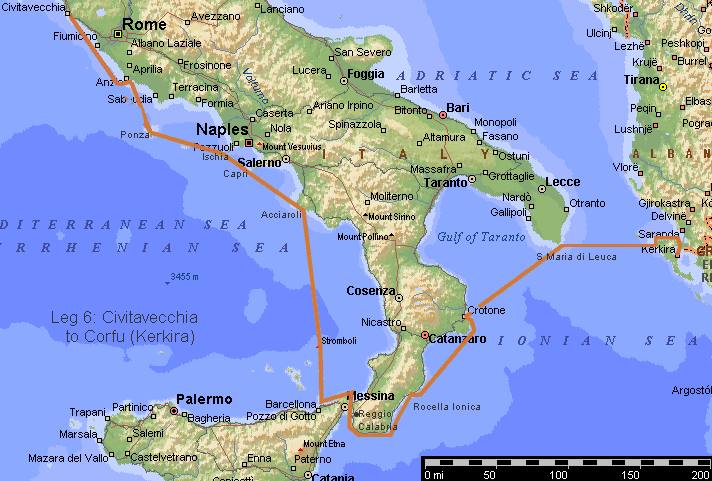
I woke at first light and was on my way by dawn for the 57 mile leg to Nettuno. I was rewarded by several hours of pleasant conditions. It started at 24° and didn't climb to 30° until 11. I had decided against stopping in Fiumere, which is small and crowded and held the prospect of mooring two deep. The wind was too close for there to be much real sailing and I was only able to turn off the engine for an hour in the morning and the afternoon. But I kept the head off the wind most of the day by sailing close to the shore and was rewarded in the afternoon by sea breezes which enabled me to come back on course.
The old town of Nettuno is right next to the port and is utterly charming. I moored in the visitor's section - alongside, sandwiched between two enormous motor yachts. After I had showered and had several drinks I went to explore the old town. I couldn't find any postcards of the old town - indeed all the postcards I've seen in Italy are boring with false colours. Maybe Nettuno just isn't on the tourist circuit, though there are hundreds of local holidaymakers parading on the front and eating in the square.
Thursday August 24 Solo Anchorage
I set out at 7 this morning but there was no escape from the intense humidity which was over 70%. Maybe I will have to try night sailing, though I am a little reluctant to do this for fear of falling asleep. But I didn't go to sleep in either of my two night sails so far, even when not on watch, so maybe I will have to consider it. But first I have to get the masthead light working. Matt did his best, but it didn't last.
There was no wind and the sea was as flat as a pancake all morning. I used the spray hood as a sun shield as there was no wind to keep me cool anyway. By 15.30 I had arrived on the Isle of Ponza and anchored in the bay well away from the tiny port. There were very few boats there when I arrived so I could anchor near the beach in around 6m. My first solo anchorage! It took two goes to get a holding, but I managed it! One of my fears in sailing solo had been put to rest.
After a swim, I ventured round to the port in the dinghy. The island is precipitous and the houses are scattered up the hillside, with many different pastel shades which make a charming scene. I cycled round the town through the tunnels which link different parts. The island is so narrow that at one point I suddenly found myself at the top of a high cliff looking out over a totally different bay on the west side.
Getting back to the boat, I was confronted by loud dance music from the beach of the most unpleasant thumping sort. I dreaded the prospect of this going on all night and wondered if I would have to go and anchor somewhere else as several of the neighbouring boats were doing. But mercifully there is no road back to the town from this beach and no restaurant and Italians have regard for their stomachs. By dusk a steady stream of small water-taxis had taken the revellers back to town and there was peace.
Friday August 25
The anchor was up by 9.15 - another sweltering day to the island of Ischia. On the way I found a useful trick which must have been described endlessly by sailors - dipping my sunhat in a bucket and emptying it over my head. It takes much less exertion than emptying the whole bucket over one's head each time and sends a lovely trickle of water down one's back. At least today there was some wind - I had the engine off for all of half an hour!
I arrived at Casamacciolo at six in the evening and had everything ready for the harbour, including the anchor, but was nervous about anchoring in the harbour and reversing onto the quay as the pilot book described. So I decided to anchor just outside the harbour, next to the moorings for small motorboats. I pumped up the dinghy and went ashore, only to discover that the harbour authorities had installed tailed moorings on most berths! (Moral: always explore the harbour first to see if things are how they are described!) I decided it wasn't worth upping anchor and moving for one night, but that I would need an anchor light. There wasn't one on the boat and I had avoided the use of one up till this point by mooring in the middle of large numbers of other boats. Here I was stuck out next to the harbour wall on my own. I found a light in a small marine and fishing shop and rigged it up on the cross-trees with a temporary circuit.
Saturday August 26
By 8.45 I was on my way again towards Capri. As I got round the headland and past the marvellous Aragonese fort next to the channel separating Ischia from the mainland a good breeze had set up, but right on the nose. I tried tacking without the engine, but gave up after half an hour as I was gaining little real ground, and with the light air it would have taken all day to get to Capri. I wanted to be there early to get a berth in the harbour.
By lunchtime I had arrived in the Grand Marina and what a chaos it is! Boats of all shapes and sizes headed in all directions with scant regard for any rules. I found the fuel berth and it was hemmed in by two enormous boats parked stern-first which didn't seem to be fuelling and the other fuel berth was worse. There were a couple of boats already on it and I had to wait for nearly half an hour to get in. My experience in the canals proved useful as I had to keep stationary despite a cross wind and stop other boats and inflatables sneaking in front of me.
I was almost there, when an inflatable managed to get past me. I really lost my cool and shouted at him (in English) to get back, which he did. It was an interesting lesson in manners, as once I had got on to the berth, he came up outside me and asked me quite normally to pass over the petrol line (which I wasn't using). In Britain my behaviour would have created an atmosphere, but here it was accepted.
As soon as I headed for the berthing area, the inevitable port authority man appeared shouting "completo" and waving his hands. I would be back on anchorage again, and this time I really would have problems with my short anchor chain. I left the chaos of the harbour and headed for a bay just to the west where there was some shallow water marked. I moored very close to the rocks in 7m, but when I swam down to look at the anchor I discovered it hadn't bitten in at all and decided it was not a safe place to anchor. But it was a good place for a swim and some lunch, so I swam ashore. But I didn't envy the Italians lined up on their sunbeds on the tiny beach, packed so tightly it was hard to find a way through.
So I headed round the east side of the island to find the anchorages mentioned in the pilot. From the sea, Capri is a glorious sight: shear cliffs hundreds of metres high and a sea arch in one of the offshore rocks which the pilot says every Italian has passed through at speed! I went right round to Marina Piccolo (where Gracie Fields retired to) and couldn't find anywhere to anchor less than 10m. So I got in as close as I dared to the towering cliffs and put the anchor down, which held despite not being long enough.
Then I had a stroke of luck. The boat next to me had an English flag fluttering from her stern: Seathrift of Deben, from Ipswich. Her skipper swam over as I was anchoring and I dived in for a chat. John and Sue were sailing out to Corfu with their daughter Clare, having bought a house there after he, like me, had been retired early. Their Westerly Fulmar is the same length as mine and it was great to find other English people heading in the same direction.
Clearly I had to lengthen my anchor chain, so I added another 12m of warp using a shackle and then went over to Seathrift for a drink, and later, supper. They had bought two extra lengths of anchor chain since leaving England, but they also had a (manual) windlass, which I didn't have. Pulling up my entire 25m of chain was tiring enough. I didn't fancy pulling up 50 or 60m on a regular basis! I would have to do something else eventually.
Sunday August 27
After a choppy night when I didn't sleep too well, I awoke as Seathrift was setting out. I had told them of my intention of trying a night sail, but when I studied the chart I realised that Acciarola, the last harbour with fuel facilities on that stretch of the coast, was only 40M away, not enough to justify an overnight sail. So I set off after them into yet another headwind.
Though the wind was SE, I reckoned that with sea breezes it would shift to SW by afternoon, so I got onto a port tack, which took me well out to sea but did at least speed me up. My theory was right and I kept having to add a few degrees to the autohelm to keep sailing until I changed to a starboard tack, which eventually brought me perfectly back to my original course. I only had half an hour without the engine, but was able to sail until the wind died as I passed Punta Licosa.
I came into Acciarola harbour and filled the fuel tank before heading nervously for my first anchored mooring. I needed to go stern-first as otherwise it's almost impossible to control everything from the cockpit - fending off, adjusting the engine and gears, throwing the mooring lines, etc. But it's always difficult in a long-keel boat such as Second Wind which has almost no steering ability in reverse. You have to get the boat pointing in the right direction and simply go for it. The port guy tried to get me to go into a 2m gap between two boats, but I chose a much bigger gap further on, stuck in the anchor and, as I headed stern-first for the quay, there was the friendly face of John waiting to catch the lines. I heard the welcome sound of the anchor chain being pulled out of the nose pipe, which means that the anchor is holding, and in a few minutes I was safely tied up.
Having a friend on the quay meant I could attempt to solve the masthead problem. So a little later, John and Clare came and pulled me up the mast. Alas, I couldn't see what was wrong. There was a voltage on the spade clips but not on the socket. In addition, I had bought a spare bulb with a screw fitting not a bayonet! There was nothing for it but to admit defeat and get some professional help at some suitable point.
So we went to the village for some much needed beers, and later had excellent pizzas at a waterfront restaurant. John and I discussed sailing tactics. He wanted to carry on doing 50M/day stints and not attempt a night. His autopilot wasn't working and that makes night sailing very hard work especially as he didn't have another watch leader. But I was still set on seeing Stromboli so we agreed to meet up in Reggio Calabria, opposite Messina, on Wednesday, if we both made it by then. Travelling with them would make my solo stint much easier and more enjoyable and he told me another useful news item.
I had been concerned about the stories of pirates operating out of Albania. Several boats had been boarded and guns produced and it meant that I was concerned about taking the northerly approach to Corfu via the heel of Italy. The alternative is a three day stint direct from Reggio and that was obviously not on if I was sailing by myself. But John reported that the pirates had overreached themselves: one had resisted a Greek coastguard and shot him dead. This was too much for the Greeks. They let it be known that any boat that didn't give way would be rammed at high speed and they may even have carried out this threat. The pirates hadn't been seen for months.
Monday August 28
I didn't want to leave for my overnight sail till 4pm, so I had most of the day free. I got tired of the beach by 11.30 and went for an early lunch. I missed the communal internet facility which closed at 1 but managed to find another office supplier which would open at 4. I wanted to check if Jeff, a colleague from work and my last chance of company before Greece, was able to join me in Reggio. There was an email from him, but sad, because his father had died and he was busy coping with that. So I would have to continue by myself.
It was time to set out. The wind had been blowing quite strongly from the NW all day, but I had been misled by a newspaper forecast which talked about "vent deboli" - weak winds. I turned on channel 68, which has a continuous forecast for the whole Mediterranean, alternately in Italian and English and spoken clearly with separated words. They were talking about force 5, something I hadn't encountered for weeks.
When I got out to sea there was a strong swell, and with the wind from the starboard quarter it made for a rough ride. As the boat tipped from side to side in the swell, the wind got round the back of the sails causing a slap-slap, to and fro. Yet the wind was only 10-15 knots and I seriously wondered whether I was being foolhardy taking on this night sail by myself if the wind increased considerably. But logic confirmed my decision. The rough ride was partly caused by too little wind rather than too much. The forecast said the outlook was force 3 and it seemed to me that it had already arrived, though they kept repeating the force 5 forecast till late in the evening.
I was now committed and as the sun fell and the stars came out I began to enjoy it. When the wind hit 15 knots I put in a reef which helped, but it increased no more, and indeed was 8-11 knots most of the night. A preventer stopped the boom slapping, but try as I did, there was nothing I could do for the genoa.
I put off dinner till 23.00 and the packet risotto wasn't at all bad. And the temperature was certainly more comfortable than the daytime. Although it only went down to 24° , I needed a sweatshirt and long trousers, clothes I hadn't worn for weeks.
Tuesday August 29
The wind continued till 3am and then, shortly after I'd put on the engine, it died altogether. As the light grew towards dawn there lay ahead of me the conical shape of Stromboli, still some 30 miles away. As I looked, I suddenly thought that they'd put a lighthouse on top of the mountain, for there was a strong flashing red light. Then I realised, foolishly, that it was the volcano itself which was the lighthouse. I didn't see the light again as the sun came up. All one could see was the smoke rising.
When I reached the island at around 11 I had a choice: I could anchor off San Vincenze, which would cost me a whole day's sailing, as it was just too far from the Messina Straits to catch the tidal gateway the next day. It was a spring tide and I knew from expeerience that Second Wind couldn't cope with the 4 knot tide that was predicted. It was an extra 35 miles to Milazzo on the Sicilian coast, but I decided to plug on as it would set me up better for tomorrow. Anchoring, getting the dinghy out and making a proper trip to the island would take the rest of the day and the anchorage isn't very sheltered for a night.
For the last few hours it was a struggle to keep awake. I set an alarm for twice every 15 minutes to check the sea (there was some traffic around). But once in the lee of the Stromboli the sea calmed down and it was a straghtforward motoring exercise.
There was one oddity: when I got within about a mile of Stromboli, my GPS stopped working. No signal at all. I carried on and when I was about a mile past it suddenly started working again. Was it an effect of the volcano, or had the signal been switched off? Since selective availability had been discontinued in April I didn't think they would turn it off deliberately, but I didn't know.
There was an empty slot in the harbour at Milazzo and a friendly Austrian on the next boat who helped me by coming on board and managing the anchor, after my anchor dragged across another rope the first time. An old fellow on the quay caught my mooring lines and then started hinting about looking after my boat. The Austrian advised me to pay him something, but I was slow getting round to it and he'd given up before I emerged with some money. There was no charge for the berth: this seems to be a benefit of harbours which don't provide mooring lines.
After I'd had a couple of beers in a local bar, I crawled back on the boat and slept from 5 till 10.30. I then went out along the sea front which was teeming with young people and had a very pleasant three course meal with fish before returning to the boat and crashing properly. I like Sicily much better than southern Italy, where everyone is so style-conscious and you could be totally invisible for all they care.
Wednesday August 30
A totally calm day. I set out by 8.15 for the Straits of Messina, which I reached by 11. I started encountering the tide several miles before entering the Strait and though there was only a very modest southerly breee there was a line of waves at the entrance produced by wind against tide and they would have been breaking I the wind was much stronger.
The straits have been feared since ancient times for their whirlpools and currents. I certainly found the tides very irregular. One moment I would be doing 8.5 knots over the ground and the next, 5.5 knots, not much more than the boat speed. But whirlpools appear only at the turn of the tide, which was two hours earlier, on springs at a few places, so I was safe from those.
The trickiest bit was coping with the ferries between Villa San Giovanni and Messina. At one point I counted six ferries and had to change course to avoid one of them. Occupied with this, I forgot about the shipping lane and was about to cut a corner when a helicopter buzzed overhead filming me. I presume this was the caribinieri and I made a quick course correction to stay within the limits.
I arrived and moored at Reggio Calabira, a thoroghly unpleasant marina right next to the entrance of the port, so that all the ferries send visiting boats rocking like crazy. The water is filthy, it has no toilets or potable water but charges £50,000 a night, the largest fee I had to pay in Italy. But there was a charming Danish couple - Stefan and Lorna - in their boat Cat Coquette, moored close by, also bound for Greece but awaiting a new engine. They came over for drinks in the evening and told me about a storm they had encountered in Portugal when Lorna and another crew member were swept overboard by a freak wave. Stefan was unable to pick them up as they were dangerously close to the coast, but they were amazingly picked up by the emergency services.
Thursday August 31 A trip on a ferry
Seathrift didn't arrive last night, though I had heard them calling me on their radio the day before just as I entered the straits (they evidently didn't hear me). So I had a choice to make. Unless they didn't stop at Reggio I must be in front of them and if I wanted company for the rest of the trip I had to wait. Reggio is a depressing city, rebuilt in concrete after demolition by earthquakes and wars. So I decided to take the ferry over to Messina. The cost was only £4,000 return, including my bike - or £1.33 in English money.
Messina is much more pleasant and keeps up with the times. I had a look round, cycled up the coast to a beach where I swam, sunbathed and sent several messages on my handheld VHF to Seathrift and scanned the channel with my binoculars, but with no effect. I was therefore surprised to sea the boat moored next to mine when I arrived back to the yacht harbour. It turned out that my strategy of a long haul past Stromboli had won handsomely. Seathright had had a difficult day on Monday after they were refused entry at Scalea (?) at 7 in the evening after a rough day and had to sail another 20 miles to the next port where they arrived at 3 in the morning. So they had to do almost as much night sailing as me, and still had a long way to go after that.
Friday September 1 The big storm
An early morning start to get round the bottom of Italy. Seathrift left at 6.30 whereas I had to wait for the fuel berth to open so I only left at around 8. But this meant that I had a following tide, whereas they had to fight against it. As we went round the foot of the country the wind couldn't make up its mind what to do and it wasn't till I got past Cap Spartivento that I got a pleasant sea breeze from the Southeast. We had 60 miles to do that day so I wasn't able to keep the engine off for long.
Then I experienced my first Mediterranean gale. I had about half a minute's warning from the white crests of the waves coming from the northwest and was able to clear the decks. A few minutes earlier the sea breezes had died abruptly and I had put the genoa away. Then the wind hit, initially about 20 knots, with steep waves that were soon dashing over the spray hood and I put the jenny up again. When it reached 25 I put a reef in the mainsail, which I was keeping pretty slack anyway, and when it reached 35 I put in another. All this time the autohelm was holding the boat beautifully. However it had luffed up a bit and I was off course, heading for the land, which was only a mile or so away. When I corrected that, the autohelm didn't like it at all and I could see why when I took the tiller - it needed a lot of pressure to keep her on course. My alteration to the rudder had unbalanced it, but at least I had the power there, which I didn't on that fateful day in April.
The wind stayed on the beam at over 20 knots for 1 hour 40 minutes, with 27-37 knots for about half an hour. By the time it subsided I was only 6-8 miles from my destination and I was relieved at not having to get into harbour in the gale. John had been worried about onshore winds making the harbour inaccessible and I gathered later from people in the harbour that waves had indeed been breaking in the entrance when the winds were SW earlier. But my only problem was that the pilot had the wrong coordinates for the (new) harbour, so I took the sails down 2 miles early.
Rocella Ionica is a new harbour built with European money which isn't properly complete and therefore doesn't charge. It has finger pontoons and I was assisted in by a young lad, who said he had charge of that pontoon. They have a snack bar which heats up frozen foots in a microwave, but it was a pleasant enough environment to swap tales of the day with John, Sue and Clare.
Seathrift had a harder time of it than me as the wind hit them more suddenly and they almost broached. Like me, they had little experience of gales at sea, though John had been a windsurfing instructor in Cyprus and was used to strong winds. Earlier they had experienced everything from headwinds to a force 6, which was entirely different to my experience. We had both heard an earlier securite warning about strong winds in the northern Ionian.
Above the harbour hung two peculiar clouds like huge tear drops in the sky, touching each other. In the light of the setting sun they were bright pink. Several of the sailors there agreed that it marked a local low pressure zone and that was consistent with the NW wind we had experienced. [In Crotone the next day I was told a similar cloud had been seen at lunchtime so it must have travelled the 70 odd miles down the coast by evening.]
Saturday September 3
After yesterday's experience I was in no hurry to be off across the Gulf of Squalls (Squallice) but John was out at 6. I said I'd check the forecast before leaving and amazingly I got the Ionian Sea forecast in English almost immediately, as reception of channel 68 had been terrible last night. It said "SW6" as we had heard the previous day, but added two words which I relayed to John on the VHF: "increasing locally". It made him turn round and come back into harbour. The Italian forecasts hadn't impressed me too much by their accuracy, but one doesn't head into the Gulf of Squalls with a forecast like that!
I had a pleasant day pottering. There was a beautiful beach east of the harbour which had good sand but was almost deserted and I swam and watched several sailing boats heading west under engine power. I didn't make it up to the impressive-looking castle above the town, but it was probably fenced off anyway and certainly wasn't "developed". I cooked a meal for the Seathrift crew, which was much appreciated.
Sunday September 4 A day for losing things
The forecast was better for today and we set off at 6 in concert for the 75 miles to Crotone. I thought it good to be within sight of Seathrift and it worked very well. We are the same size and though they have a better engine it seemed to make little difference once we were out at sea. It was calm in the morning and I didn't put up the sails till 11.45 but by 14.00 I was able to turn off the engine and sail on a very pleasant southerly wind which gave an adequate 4.5 knots most of the afternoon. I had originally planned to stop at La Castellata, but it didn't have any fuel and I wasn't sure of making it all the way from Reggio across the Gulf of Taranto if we encountered some strong headwinds, so I agreed to go on to Crotone with John.
As we rounded Cape Rizotto the southerly wind moved round with us until it was southeasterly and we were sailing goosewinged into Crotone. At this point I took over from the autohelm which had developed an annoying habit of veering 20° each side of the course, not a good thing when gybing is a possibility. Unfortunately I was checking the GPS and not keeping a good eye out either and the boom did an uncontrolled gybe sending the left traveller stop flying. It hadn't been seating properly for several weeks, although it was brand new when I set out. In turn the traveller took the rubber end stop, which was also dodgy, with it the bottom of the tackle flew out towards the boom and I was left trying to sheet in a very long rope. There was nothing for it but another rather more controlled gybe and head into wind, where I was able to refit the tackle and traveller and complete the rest of the journey making very sure there was no repeat performance. In the manoeuvre I lost my sunhat overboard and earlier in the day one of the sail ties vanished into the water. Just one of those days!
Crotone has a nice harbour. They are developing the yacht club moorings so they have water and should soon have electricity and there's plenty of room for pontoons as the need arises. The guy on the fuel quay was very conscientious, making sure I saw the zero on the pump before he started and being very indignant when John produced a filter funnel at the very hint that his fuel might be dirty.
We were pretty exhausted by the long day but John and I managed to walk far enough into town to order some pizzas and bring them back to the boat. Clare had strained her back pulling in the genoa and both women were obviously very tired and I was glad when John admitted to it and suggested they might spend an extra day in Santa Maria di Leuca before crossing to Corfu. His brother (with whom he shared the boat) was arriving in Corfu on Tuesday and I knew he had set his heart on arriving that day.
Monday September 4
We set out in the dark at 5.30. Seathrift snarled up on the mess of mooring lines - several boats had used two. They don't seem too familiar with them in this part of Italy. There was a hint of a northwesterly at first, but having put up the mainsail as we passed the oil platforms outside the harbour I was forced to take it down again after quarter of an hour as the wind was all over the place. But there was quite a swell coming out of the Gulf of Taranto and it was a tippy morning until lunchtime when a southeasterly wind developed, though I couldn't turn off the engine. Soon the ETA of 20.00 turned into one of 18.00, a relief as I felt increasingly tired during the day.
Seathrift had put up its sail an hour earlier than me at lunchtime and had crept nearly a mile ahead. I recovered some of this by steering a better line with my GPS and the opportunity to equalise things came when a tanker crossed our path about 5 miles out of Santa Maria. Seathrift had to tack to avoid it, but being further downwind I was able to bear away and cross in front of the tanker giving me a comfortable lead. But John had been clever. He used the diversion to take down his mainsail, and when I took mine down a mile from the harbour (which took longer than usual as I was tired) he regained his lead.
The visitor's berth at Santa Maria is on the outside of the new pontoons and the swell and the arrival of fishing boats made the boats tip around alarmingly. Seathrift's mast was rocking perilously close to the next-door German boat. We tried various ways of stabilising it with no success and eventually persuaded the guy from the port to let her moor alongside. All this took till 9 and it was 11 before we got back from a meal and hit our bunks. But the jerks on the mooring lines kept me awake for another hour or so before things calmed down.
Tuesday, Wednesday September 5 - 6
A cold front came over and with it thunderstorms and forecasts of high winds. John had mercifully abandoned earlier thoughts of going off this morning and we stayed in port for two days. The temperature dropped to 20° and even swimming wasn't much fun. I did get a few minor repairs done.
The boat next to mine in the harbour belonged to a French college teacher called Isidor. He is crippled below the waist but sails single-handed in his 9m yacht called Baladin II of Southampton. He has his boat adapted so he can do everything from the cockpit: hoist and lower the sails, reef, anchor, even pull up the fenders. He assured me he never goes on deck whilst out at sea. He has a year off from work and is trying to get to Israel. I admired him tremendously. Like me, he's had friends sailing with him on some of the legs, but he is sensibly cautious with the wind and waits for the right conditions.
Since I have my disabled friend Guy coming out in a week's time I realised it was time to think about some of the basics - such as how to get him up my long rough plank onto the stern of the boat without having a third person to hang on the other end. Isidor pulls his boat to within 6" of the quay but has a gap in the rail and doesn't use a passerelle. So I got my plane out and smoothed the plank. Another useful suggestion was to have a seat belt rigged up in the cockpit to support him while at sea. An old safety harness proved to be adequate for this.
Thursday September 7
Finally the weather forecast looked ok: N4/5. So by 5am Seathrift and Second Wind were out of the harbour and there was a healthy NW wind blowing 13 knots. I put in a reef as it was still dark and it might blow up clear of the headland, but kept the engine on. Seathrift was going all out to reach Palaokastritsa and I thought I'd stay in touch.
Looking east there appeared to be another cape 5-10 miles east of Capo S. Maria. I even went down to double-check the chart - which did not of course stretch across the Ionian Sea. I was sailing for the first time across a stretch for which I hadn't a chart - my next chart was of Corfu. When dawn came, I decided it was just cloud, but it persisted and eventually I realised I had been seeing the mountains of Albania, 70-80 miles away. They were with me all day, though considerably more hazy.
With the dawn the wind settled down to N3-4 and I turned off the engine, took out the reef and had a really good day's sail. Gradually Seathrift, which kept her engine one, crept ahead of me till it eventually disappeared, but I was only 5 miles behind at the end of the 65 mile journey.
As I approached land the wind started to back with land effects and it was useful to confirm this by radioing ahead to Seathrift. So I drifted a mile and a half downwind so that I was able to sail into Palao bay without too unpleasant a following wind. I came into the tiny bay where Seathrift was anchored and narrowly missed some rock a metre below the surface which was not where Haskel said it was. I wasn't too happy with the holding, but it was peaceful in the bay so I left it there for the night.
John's family were renting a house right on the sea front, so I took the dinghy to meet his mother and brother. But I was tired, and soon after changing a few pounds into drachmas at the local hotel I went to bed. I've made it to Greece!