


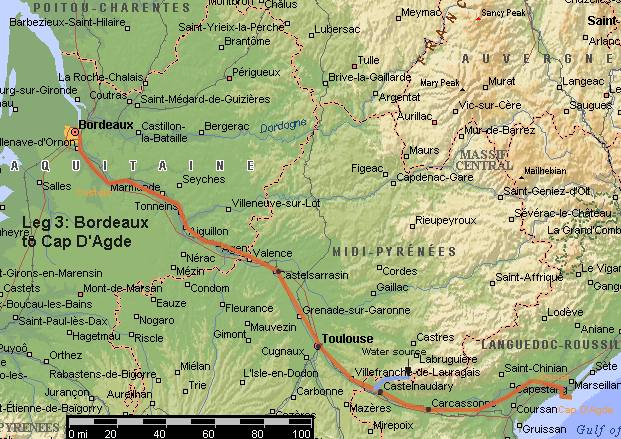
Monday July 10 Out of tidal waters
At around 9.30 the ebb stream in the river had slackened to the point that it looked easy to get up to Bordeaux to do essential shopping, so Donna and I slipped Second Wind from the berth and headed up the river. Bordeaux looked more impressive from the river with its central district looking proudly out than it had on Sunday when it was closed. But when we reached the Pont de Pierre - an old arched bridge with about 10 spans - the currents started swirling and I had to grab the tiller from Donna and crank up the revs to keep us safely in the middle of one of the channels. Even with full revs we only had half a knot to spare even tho it was only 1 1/2 hours before slack water. But we made it safely through and tied up at the small pontoon on the right bank that M. Froudilhoc had told me about. The quay was locked and to get back to it we needed a key, so I went searching in the workshops nearby leaving Donna there and found someone who would loan us a key so that we could both go shopping.
We found a small grocer and other shops and by 11.30 which was when the tide table showed slack water there was already a good flood tide running and we headed off up the river towards Castlets which we reached by about 4.30.
This was our first lock: we managed to moor below the bridge as the instructions showed and waited a long time for anything to happen. Eventually the lock keeper had to walk down and tell us to enter. For this and the first few locks there was a ladder inside the lock which I climbed carrying two warps. We approached very cautiously and I did all the hopping out of the boat while Donna steered.
The lock keeper went through the instructions, in French, for negotiating the first automatic lock which we had to negotiate that evening. He repeated himself a number of times and I got bored and turned and he turned to Donna, presuming that I couldn't comprehend anything. In fact the automatic system is very easy to operate. About 200 metres from the lock a rubber tube hangs from a wire suspended across the river and one gives it a half turn, to operate a simple contact switch which starts the cycle. A red and green light shows that the system is ready for this to be done and there is another pair of lights by the lock. When the red light goes out leaving only a green, one can proceed into the lock. When safely tied up, one operates another switch by the kiosk, which closes the gates and starts the lock filling. When it is full, another twist on the switch opens the other gate.
Having gone through our first automatic lock, we decided we had had enough for the day and moored alongside a beautiful Dutch sailing barge, whose owners Rudi and Ria were very welcoming. He amused us by explaining the automatic system rather differently in terms of the number of light bulbs out of action: if there is only a red, that means the green bulb has blown, etc. etc. - a useful warning as we later discovered. The two of them manage the 25m barge with all its masts and sails and claimed it was easier to manage than our small boat! But he could say that, he was a retired professional. They sailed the Med and the Gironde all summer and wintered in the canal. Their barge had huge cabins which were a match for most small houses and they seemed to know all the locals, so it couldn't be an isolated existence.
We followed their advice about eating in the local canal-side café, which served excellent food. Donna had eels, which Rudi had recommended. We decided to eat out on alternate evenings, with lunch normally on the boat so as not to waste time.
Tuesday July 11 The bilges are flooded!
We got up late. Relief from having got out of tidal waters made us want to hang around, but by mid-morning we decided to leave and get used to the locks. What proved to be the trickiest part was predicting which side of the lock had the ladder, bollards and switch. They seemed to come randomly on left and right with no easy way of spotting it from a distance. Initially I did most of the climbing and hauling, and Donna did the steering and stopping, which was also quite challenging for her.
We reached a refuelling station and filled up with diesel and water. The top of the starboard water tank leaks and soon a dribble of water appeared on the floor as had happened a few times previously. But this time it seemed worse so I decided I'd better clean up. There was some water around the hatches which hold the batteries, and imagine my horror when I lefted one of the up and found the bilge water coming right up to the cabin floor! This was what the surveyor had warned me about when he recommended putting the batteries higher up. Now they were totally covered!
I leaped on deck and steered the boat towards the side of the canal
where we went aground. Ignoring this, we turned off the engine and started
bailing as fast as possible, using cups, saucepans and whatever we could
find. As the level went down we explored the other compartments and tried
to work out where the water was coming from. There was some diesel with
the water and I found that one of the diesel inlet pipes had worked loose.
The gland on the back of the water pump was also leaking a little, but
not enough to create that amount of water. The very front compartment was
full and appeared to continue filling when we emptied, introducing the
worring possibility of damage to the hull, though none of the minor bumps
I'd had made that seem reasonable.
Having cleared off the battery terminals I nervously switched on the
power, expecting the batteries to be dead. Amazingly, they seemed entirely
normal and the engine started with no trouble. Soon the cause of the trouble
was obvious: a flat rubber panel in the silencer had a hole in its side
through which water and exhaust fumes were spattering over the prop shaft
and fuel tank. We had nothing on board to stop it, so we could do nothing
except keep a close watch on the level of the water while we carried on.
Thinking about it later, I breathed a huge sigh of relief that it happened
in the fresh water of the canal. Had the batteries been covered with sea
water, I doubt they would have survived.
As a result of all this we only passed through 7 locks today and covered
9 km. We moored at Villeton.
Sunday July 16
Finally we are in the Canal du Midi! The first lock was 6.2m high and is the largest lift on the whole canal. Donna couldn't throw that high so I had to go down the very slimy ladder to pick up the ropes. After negotiating three locks, we tied the boat to a tree along the edge and went to see if Toulouse was as deserted as Bordeaux on a Sunday.
No, it is full of life, with markets and cafes full of people. One of my aims was to find an internet café, and after straying through the red light district, we found a receptionist in one of the hotels who told us, in a delightful Irish brogue, how to find the official internet kiosk. When we finally found it, we found two machines, both broken; later we did finally find a working kiosk in the street, but it had no keyboard and though I was able to check incoming email, it would have been impossible to compose a reply using the on-screen keypad. Maybe France Telecom still prefers us to use Minitel!
We set off again through the suburbs of Toulouse and reached Port Sud, where we met David and Rosemary again, who were able to entertain for tea, the only drink we had on the boat. I also picked up a guide to the canals (Guide Vagnon de Tourisme Fluviale) which full details of all the locks and services near the canal. It's less interesting than the small book by Tony Paris, but it took the guesswork out of planning how many locks we could get through before the lunch or evening closures.
The locks on the Midi are an entirely different shape to those on the Lateral. Their oval design means it is easy to get two boats abreast and even four in at a time if they are small enough. But they don't have convenient steps or ladders, except on the gates, so it is necessary to drop someone off on the bank unless there is a lock keeper to throw a warp to. At first we found convenient mooring places just before the lock, but often the water was too shallow to get within jumping distance, despite the fact that at 1.3m draft we were well below the 1.6m maximum permitted in the canal.
Monday July 17
We needed to do some shopping and the first village to show any possibility was called Donneville, so we stopped to see what Donna would find in her village. Alas, even the boulangerie was closed and our only prize was a roll of parcel tape to keep the muffler from leaking further.
We were luckier at the next lock, where the eclusier pointed us to an Intermarche hypermarket a couple of kilometres further on. We did our first proper shop and pushed a loaded trolley half a kilometre back to the boat with plenty of bottled water and stronger drinks. I then road the trolley back to the supermarket using the foldup bike which I had brought out the night before from its storage place.
We plugged on up the summit of the canal and made it to Port Lauragais by 6.30pm. Here there is an exhibition about the building of the canal and the port serves also as a service station of the motorway. The exhibits are mainly old photos and not very exciting as they fail to tell the story of the canal which is most intriguing. But the reason the exhibition is here is that the watercourse which made the whole canal possible is close by. So after a drink, improved by ice cubes begged from the restaurant, we set out to find it. It was getting dark by the time we reached the top lock of the canal (L'Ocean) and started walking past magnificent avenues of trees erected by the grateful heirs of Paul Riquet, the collector of salt taxes, who conceived the canal and supervised its construction but didn't live quite long enough to see its opening in 1686. We found the obelisque erected to him but it was too dark to continue.
When we were back at the lock we rashly decided to cross it and take what appeared to be a short cut. The road shrunk to a track, then a field and finally when were in sight of a railway we had crossed earlier, we came to massive undergrowth and a seemingly impassable drainage channel. Could we face the prospect of returning to the lock and a dark walk down the other side of the canal? Though it was very dark as the moon hadn't yet risen I resolved to have a go at finding a path close to the canal. After several defeats I found a concrete slab on the canal bank crossing the drainage channel and after checking that it went through had to fight my way back through the jungle of trees and undergrowth to bring Donna through. I admired the way Donna hadn't panicked and had persisted in the pitch dark.
Tuesday July 18 Starting the descent
The last upward lock! We passed through L'Ocean at about 8.30 and were soon passing the Rigole du Bassin de St Ferreol where the water source came into the canal. This was the secret of Riquet's canal. He had realised that the Black Mountains 30 miles to the north had plenty of water throughout the year and could be brought down to this point which was the saddle-point of the watershed between the Atlantic and the Mediterranean. Nobody had ever constructed a canal between two oceans and it took all his fortune in addition to the deep coffers of the government of Louis XIV to realise the project. The dams that were constructed up in the mountain survive to this day and the canal is substantially as he left it.
Soon we came to the first downward lock: La Mediterranee. It proved remarkably easy and I realised that handling the locks single-handed on the way down wouldn't be such a big deal after all. Going up is quite tricky: the turbulence of the water, inconsistency of design of the locks and the absence of lock-keepers on the automatic locks made handling the boat single-handed a nerve-wracking prospect.
About a week earlier I had called the friend who was due to replace Donna when she left at the end of the week. I discovered that her doctor had forbidden her from coming! This caused me something near panic as she was due to come for two whole months and I didn't know how I was going to cope. One person I had called was another friend called Suzy and coincidentally I got a response from her today to say that she could indeed come in about a week, which should see me through the rest of the canal.
Once over the top, the canal starts descending rapidly. The biggest fall, 22m in 3km, occurs after the first big town on this stretch, Castelnaudary. Here Riquet constructed a large basin to act as a reservoir for the 9 locks that occur in that distance. We moored in La Grande Bassin and I went off to find the mechanic at the Blue Circle Line which has its workshops here to try to solve the problem of the leaking silencer. The Blue Circle Line is British owned and operates most of the hire craft on the canal. The mechanic didn't speak much English but he was very helpful and even searched the attic to see if he had a spare silencer up there. He didn't, but what he gave me was the phone number of Marine Diesel who would forward a package to a Poste Restante address and the name of an anglophone to talk to. I called him up and placed an order for a new silencer to be sent to Carcassone, where I could wait if necessary for a few days.
Though the town of Castelnaudary is described as "the second most picturesque" of the canal, a walk around it showed the houses all constructed of a rather characterless gey concrete, though their red roofs look charming enough from the water. So we were able to resist the temptation to try the cassoulet for which they are famous in order to reach Carcassone before Donna had to leave. We descended through the first four locks alone. All the locks were electric-powered and a lock-keeper controls them all from a high tower from which he can see everything. Efficient, but a bit impersonal.
We made good progress, but failed by one lock to reach the mooring by the village of Villepinte, where Paris recommended a couple of restaurants. Mooring was difficult as we couldn't get with 2m of the shore on either bank and ended up by ramming the boat towards the bank and putting out anchor to keep secure. We wanted to find a restaurant, but Villepinte was too far to walk, so we decided to try Pexiora, for which the Guide Vagnon gave a knife and fork, although Paris only said it had a snack bar. After a long walk past fields full of sunflowers glorious in the setting sun, we discovered that Paris was right. The only solution if we were to find a restaurant was a taxi. But by the time one turned up and got us to Villepinte, its two restaurants had finished serving and the taxi driver suggested a Les Routiers café a little further.
It was a brilliant suggestion. I'd heard of these establishments where truckers are served excellent French cuisine but had rarely experienced one. This was it - quality without style! A five course meal, with wine, for 69FF, served on long tables, with an almost totally male clientele in shorts and working clothes. The irony is of course that English lorry drivers wouldn't pay £7 for a meal, or enjoy this type of food. With the taxi back, transport cost us twice as much as the food, but so what? It was an experience!
Wednesday July 19 Mayhem in the locks
Getting the boat off the bank proved difficult. The engine wouldn't shift the boat, nor the anchor, nor the pole of a helpful passer-by. A cruise boat on the opposite bank with six inhabitants who had watched our struggles the night before trying to moor without once diverting from their card game were enrolled by the passer-by to help us, but only after they finished breakfast. This was enough to make me make one last effort: the anchor without the engine finally pulled us off and we were on our way.
For the first time, there were enough boats on the canal that we hardly entered a lock by ourselves. Many of the boats were hired by people who had no experience of boats or locks. Their antics were hilarious, except when they threatened to cannon into Second Wind. Since we often had to go through several locks with the same boats which might take at least five minutes to tie up, I made a point of helping and passing our, by now, extensive experience. After all it saved us lots of time. This worked quite well until we reached a lock where a number of boats were waiting after a tree had blown down the power cable serving the locks motors. Luckily the lock started soon after we arrived and the keeper said we could get four boats in the oval shaped lock.
It was a deep lock and halfway through the cycle, the boat opposite us which had taken a long time to get sorted out had a problem. The women holding the stern mooring rope found it a bit short, and instead of holding on for dear life as the level went down, she simply let go and coiled the rope neatly.
The result was inevitable: the stern of the boat swung out till it was hitting our boat. I wasn't too concerned as their boat was totally plastic, but I could do nothing as our rope was a bit short too and there was a shortage of bollards and I was on the quay hanging on to our boat. The lock-keeper eventually noticed what was happening and told the front boats to clear out, which left our companions at right angles to the lock, mercifully by now clear of our boat. The man on board had no clue what to do and was driving backwards and forwards across the lock getting nowhere. What would have happened if Donna (who was at the bows) had not thought to tell the woman to throw her the stern rope, I don't know. But with the stern firmly attached the boat's bow quickly swung round with the current in the lock and we were able to get out.
We reached Carcassonne at about 3.30pm and went through the lock and moored on the stretch following the railway bridge. This has good shade in the afternoon when the heat is at its worst, though the water was rather shallow.
I wanted Donna to see the classic fortified town which is on the outskirts of the modern town. I had visited it once before and been enchanted by this much filmed edifice. The afternoon was still burning hot and we found our way up to it with the help of a few drinks and ice creams, but arrived too late for the guided tour. But we enjoyed an excellent degustation and even a cassoulet in one of the many restaurants in the streets inside, before making our way back to the boat.
Thursday July 20
Donna left on the 9am train. Suzy isn't due to arrive till Saturday, so I mooched, did some laundry and found an internet café. Here I was finally able to set up my laptop to send and receive emails from the boat using the mobile phone, by registering for an IPASS, which provides ISPs in many countries. I should have done this before I left home and I had to download their software to a floppy disk in order to set my machine up. Mercifully, this internet café was better than the offerings of Toulouse and I was able to get up to date. The silencer hasn't arrived.
Friday July 21
At 12 I went down to the Post Office and the silencer still hadn't arrived. So I called Marine Diesel and they said it had been dispatched and gave me the reference number. At 2.30 I went back and it had arrived! Getting the old one out took an hour in the sweltering heat, but after that it was simple. The engine ran beautifully and there was no more need to pump the bilges!
Saturday July 22
Suzy arrived late in the evening. I had searched for a restaurant which looked out over the old town but there was only a single hotel and it stopped serving at 10pm which was when she was due to arrive. When she did arrive she had a sore ankle from a sprain some weeks earlier and we found the nearest restaurant across the river. But it served an excellent fish dish.
Sunday July 23
Since Suzy wanted to find a church and see the old city, we walked in the morning and finally got on our way later. People on the canal had been warning me for days about low water levels at Trebes, but we got through without any problems. We made it to Marseillete where we found an extremely pleasant Logi de France for a meal.
Monday July 24
We carried down through a number of locks. Suzy could do a great deal because of her ankle but by this time I could manage the locks well by myself so it didn't matter. We reached the start of the long pound - 54km of canal without a single lock - by the end of the afternoon and stopped at Ventenne next to a boat on which a pleasant English couple lived during the summer whilst renting out their house nearby.
Tuesday July 25
The long pound is incredibly beautiful. It's contoured on the north side of the Aude valley, which is covered with vineyards and red roofed villages, with forts scattered across the surrounding hills.
There was one mechanical incident. We had stopped by the bank and on starting again the engine had little power and started black-smoking at low revs and then vibrating. It all pointed to weeds round the propeller and I donned my goggles and had a swim. It turned out to be a plastic bag that was firmly caught. Mercifully the water was warm.
We carried on through the day, through the charming village of Le Somail and the tunnel at Colombiers, the first canal tunnel in the (western) world. Finally we arrived at Beziers, though we were too late to go through the 6 lock staircase, which has two hour shifts in each direction, the last downwards one finishing at 15.30. But it turned out that later that evening there was due to be the first performance of a "spectacle", staged around the bottom lock where the canal turns to go across an aqueduct, about the construction of the canal.
Three hours before it was due to start, a gigantic thunderstorm broke. The stage hands were still sweeping away the water just before the performance was due to start, but things weren't delayed too much. The French certainly know how to stage such performances and the action was vigorous and elaborate, with horses, courtiers and fireworks. We didn't catch too much of the dialogue but the plot was mostly clear as I had by now read a history of the building of the canal.
Wednesday July 26
Finally we reached the end of the canal, or at least the point where the river Herault leads down to the sea at Agde. There is a curious three gate lock which is circular inside. It was just opening as we arrived so I went straight in, only to be told that the river exit wouldn't open till 4.30, but there was plenty of room to turn, so I came out and moored up.
The lock-keeper asked whether I had a virement for the canal. Ever since Bordeaux I had tried to find out where to pay the small sum that is required for both canals and had repeatedly failed to do so. Here at last was an office of VNF which was actually open. But they wanted payment in cash and I had to walk to Agde to get enough.
Agde is a lovely old town which dates back to 500BC. The (fortified) cathedral looks somewhat crude with its huge black blocks of volcanic rock, but there are lovely squares bursting with life and tourist restaurants along the river. Suzy decided to catch a bus down to the sea for a bathe as this was her last day and I spent some time trying to find a mooring place along the river. It was 4.15 by the time I got back to the lock and I scraped the bottom, which was concrete, on entering it. Another boat, deeper than me, made a frightful noise as it moved around the lock. Why it should be so shallow I don't understand, as it doesn't reduce the amount of water that is needed to fill the huge lock.
We got out into the river amidst a pantomime of officials running around with virements and papers. The whole trip through the canal cost me around 210FF - less than 2F per lock! He nearly dropped my 200F note and a 20F coin disappeared into the water.
Mooring the boat in the river proved to be very difficult. My first attempt, at a small marina just below the town, was a disaster. The owner had assured me earlier that it was ok, but when I jumped onto the rickety little pontoon I realised immediately it was nowhere near big or stable enough for my boat. Though I pushed straight out again, it had a very sharp corner which left another nasty little gash in the side of the boat. Coming back into conditions of wind and tide was a shock after the peace and quiet of the canals.
I cruised down the river to the sea and could find nothing. There were private moorings on the right hand bank and small fishing boats on the left. There is a 12m high bridge halfway down which is just too small for my boat which measures 12.47m without the aerial, so I couldn't use a boatyard in the town and a boatyard further down refused me entrance. So in the end I returned to the town and moored on a small landing stage in the centre, which I hoped wouldn't attract attention as long as I left early in the morning.
Thursday July 27
Suzy left by the 6.15 train and by 9 I was off down the river and out into the sea to get to the huge Cap D'Agde marina. Straight away I ignored the pilot book which advised visiting boats to round the Vauban-built tower which marks the cape: it was such a clear day that the straight route seemed far more sensible. But I was nervous being in the Med for the first time and by myself and it seemed daring to be taking these decisions. Before long I was tying up at the Capitanerie.
Many of the boats were moored fore and aft so I asked for help in berthing. A pleasant lad from the Capitanerie set out with me in a launch across the bay which has been formed by large breakwaters leaving enough room for dinghies to have good sheltered sailing inside. I needn't have worried as the pontoons I was allocated to were better than those in England, with one finger per boat space. The French neighbours were also very friendly, helping me when I had to turn the boat to get at the electronics on the masthead.
It was a blisteringly hot day and though I had to prepare for putting the mast up I couldn't face it until the evening, so I found my way to the beach on the eastern side of the promontory, where I had a refreshing swim and sunbathe, though the beach was rather packed. Later on it did cool down and I got most of the rigging sorted out. My careful labelling of the shrouds paid off and I loosened the mast in preparation for putting it back up.
My entry in the CA skipper list finally paid off today when I confirmed an experienced crew member who had called from Dublin. Margaret agreed to come through the Med with me throughout the month of August and would arrive next Wednesday at Nimes. So at last I had crew to get me through Italy as far as Messina. I also had a call from Mark, one of the lads in Poole who wanted to sail the Atlantic and he said Matt and he would also come to make up my crew across Corsica to Italy. Finally Donna called up from Crete saying that she would like to do some more sailing and so I arranged for her also to meet me next Wednesday in Port Camargue, about thirty miles along the coast.
Friday July 28
In the morning I got most of the masthead electronics back on and repaired the Windex which had been half broken. The most difficult was the masthead light which I tried several times to glue into place with Araldite and only finally redrilled it at the suggestion of a friendly Englishman called Derek. This required several visits to the chandlery including buying the necessary power adaptors for the rather strange plugs they have there. But the wind was very strong today so I didn't hurry about getting the mast up.
In the evening I was invited for drinks by Derek and Jann aboard their lovely 34' wooden boat called Great Days. They have spent two enjoyable years sailing the long way round Spain from Falmouth to get to Agde and are planning an extended trip into the canals. So I was able to give some help - including old tyres and sheerlegs - as well as gain plenty of useful advice about the Med.
Saturday July 29
The mast finally went up after lunch. There was still a great deal of wind on the pontoons and all the neighbours lent a hand in getting me out and back. The port used the big crane for the job: very efficient and it only cost 90F. The only casualty of the operation was the aerial for the MF radio which was attached to the backstay. I was at the bow fixing the forestay at the time and so wasn't able to keep an eye on it. I spent the rest of the day making sure of the rigging.
Sunday July 30
The windex was swivelling wildly so Derek lent me an excellent tackle with a 3:1 advantage that he had constructed so that he was able to haul himself up the mast. The disadvantage of this arrangement was that it was about half a metre long at the top so I wasn't able to get my head over the top of the mast and had to tighten the screw by feel. It was soon swinging freely again.
It wasn't till after I had been up that I reconnected the mast foot electric fittings. After I had done this I realised that the tricolour wasn't working. But that would have to wait for another day.