


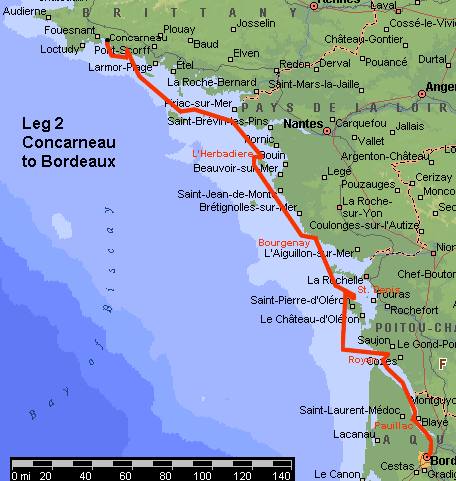
(click on map for detail view)
(click on map for detail view)
Today is a waiting day. My second crew, Robert, doesn't arrive in Concarneau till tomorrow. He's an old friend from university and is a yachtmaster with much more experience than me, so I feel confident for the next stretch down the Bay of Biscay with its notorious winds and swells.
I talked to the instructor of a school boat moored next to me and he strongly advised a professional repair to the sail. He recommended a 'voilerie' on the quay, which didn't open at all on Sunday even though it said "apres-midi" and I lugged the sail down.
In the afternoon I visited the walled city. A group of Breton players was performing outside with a mix of Irish, French and Bolivian members. Their flutes, guitars and accordion fitted the atmosphere of the place superbly and I enjoyed a walk round the town despite the overwhelming number of souvenir shops.
I also managed to get the SSB radio working and was able to tune to a couple of weather maps, though the quality wasn't good enough to get good data from them. I need a better guide to the frequencies and other programs if I am going to be able to use it effectively. But it wasted the evening quite effectively.
Monday July 3
Down to the voilerie at 9 o'clock and I managed to persuade the proprietor to have the repair ready by 4pm though he offered it only by tomorrow morning at first. Then I made a long phone call to my mobile phone company in UK. They claimed that I should be able to connect my mobile via Bouygtel. A helpful assistant in a local shop had shown me how to make the network connection, but it had been refused at that point. But after the man in UK disappeared for several minutes and said it was ok, I tried again and it worked. My communication plans were getting back on track even though I failed to pick up my email using either British or French providers.
Robert arrived at 1pm having left his car in Rennes where he stayed overnight. After a crepe lunch and another visit to the old towm we picked up the sail, which had been mended beautifully, and set off at about 5.15 to get on our way, planning an overnight stay on the Belon river.
About half an hour out of the harbour, the autohelm packed up! The first sign was that the boat suddenly veered off course, which it had done on a few previous occasions. But this time not only did the + button move the arm out, but the - button did also. No pressing of the buttons would withdraw the arm even when I wound it back manually.. We were unlikely to get it fixed quickly so there was no alternative to manual helming for the next few days.
As we reached the open sea we finally found a bearing we could sail on, and continued to the Aven river which looked easier for mooring than the Belon river next to it. We went about a mile upstream to find water less disturbed by the SE swell at the entrance.
What a glorious setting! Green trees, violet heather, small castles looking out over flat creeks. I could see why Robert had earlier chided me for not spending weeks "rotting on the Belon river" as he put it. We found a spare mooring buoy and hooked a trailing line to the stern, which turned out to be not very effective when the tide turned as we landed up at 40° to line of the river. But we were out before anyone stirred in the morning, so it mattered little.
Tuesday July 4 A Magnificent sail past the Belle Ile
This was a truly magnificent day's sailing, when we covered nearly 80 miles over the ground. The wind was in the south-west around force 4 for most of the day and we were travelling SE. We originally set our goal on Le Croise, close to St. Nazaire, a distance of about 60 miles, though I was secretly hoping we would make it to the Ile de Normantier, which would give us a good 20 miles more on our way, and this was what we eventually achieved.
We left the Ile de Groix well to port with a fine Biscay swell making the sailing exhilarating and passed inside the Belle-Ile, reaching slightly calmer water just before we entered the La Teignous channel. Robert had suggested that we go through this so that we could run down in the shelter of the next chain of islands, Houet and Hoedic. The channel proved to be the most exciting sailing I'd had so far, as we were on a dead run in a wind against tide situation, which made really lumpy. I was glad for the GPS being able to pick out the mile-wide channel as it wasn't at all clear when to turn into it from the markers, and we would have had to use bearings from the lighthouse otherwise. After a couple of involuntary gybes, which were inevitable given the way the boat was bucking around, we turned right behind the islands and rewarded with a beautiful sail down their lee. By coming down this side, we had kept our options open about a shorter or longer trip. I was learning the value of this, as it is impossible to predict sailing conditions throughout the day. As it turned out, the wind continued to blow from the southwest and we decided to carry on across the mouth of the Loire and on to Normantier.
In the Loire channel, the distances played a strange visual trick on us. There were three large tankers, two coming out and one going in. The one going in appeared stationary but the bearing of the second of the outgoing tankers remained strangely constant despite our changing course to avoid it. It wasn't till we were about 1/2 mile away that we realised that it was the two we thought were going out that were in fact anchored, the incoming one having moved well out of the way by this time. We continued round the stern of the Russian tanker though I felt a bit stupid at not considering that possibility earlier.
By 8pm we were moored safely in L'Herbadiere outside another boat on the untidily parked visitor's pontoon. We walked into the town and found an excellent restaurant where we enjoyed real French food for the first time.
Wednesday, July 5
We left L'Herbadiere at a comfortable 9.30 and headed out round the headland, against the wind but aided by the tide, and so into another bumpy ride. From here we were just able to put up the sail and make a bearing for the end of the long island. There were several boats trying to keep the same course and Robert tried to keep us further out than others who sailed into the bank and then had to tack. But all the same they gained half a mile on us in the process.
By lunch time we had to start the engine again and motor sailed all the way to Bourgenay, which is an artificial construction along the coast from Sables D'Olonne, but left us in a better position for the next day.
Thursday July 6
Our choices were not easy today. With perfect winds we might have made the 70 miles to the Gironde, but failing that we had an easy run to St. Denis. Robert was in facour of going round the Ile de Re and past La Rochelle, but the tide wasn't favourable and I wanted to keep our options open, so we took the direct route to St. Denis. We had a good sail with winds of 18-22 knots for a couple of hours and just as we reached St. Denis the wind died entirely.
We were a couple of hours early for the tide to reach the sill going into the marina, so we moored outside and I had a very pleasant swim. It was the first test of the ladder I had installed at the back of the boat. It is just the right length to haul oneself out. It was baking hot when we arrived in the marina and there were a number of English boats there. They warned us about severe storms that evening. We saw the storm clouds which passed 20 miles south of us. But St Denis had the feel of the South of France, with beautiful flowers along the roadside, and the heat made us feel that we were definitely out of Brittany and approaching the Mediterranean.
Friday July 7 Heaving to
Winds force 6 and 7 were forecast this morning and as we set out I noticed a number of the other boaties looking apprehensively and admiringly at us. We put up one reef before leaving port and rounded the Pointe de Chassion in a healthy force 4 which soon increased up to force 5 - 20 gusting up to 25 knots from WNW. At this point we realised that we would arrive at the mouth of the Gironde several hours early for the tide and put in another reef and gut back the genoa in an attempt to slow down. These measures had little effect on the speed, but did produce a balanced boat which was most pleasing to me, as I had put so much work into correcting the weather helm.
We reached the mouth of the Gironde about 5 miles upwind of the first buoy and hove to in my first attempt to see how effective the technique was in Second Wind. It turned out excellently. We ended up almost at right angles to the wind, which which meant that we rode up and down on the 3m Bay of Biscay swell in total peace and quiet. The rudder hardly needed lashing and we took our cups of tea in peace. In an hour we covered little more than a mile and drifted only 1/4 mile downwind, though we were helped by the ebb tide. After a second hour we were back within 1/2 mile of our original position.
By this time the tide should have been turning and we were still five miles from the first buoy marking the river. But as it turned out we had timed it perfectly as the last of the ebb tide, which was producing heavy seas further in, disappeared just as we approached the shallower water.
The pilot books all spoke of the need for recently updated charts of the Gironds and I hadn't managed to update mine, which were 8 years old. It quickly became apparent that the buoyage in the river had changed substantially and the possibility of sailing up to Pauillac in the dark, as Robert wanted, was just not there. So we decided to put in to Royan, just opposite the Pointe de Grave at the mouth of the river, which we reached about 8.30pm.
I was really exhausted after 11 hours of sailing. It was the Bay of Biscay all right - strong, but not unpleasant, winds and big swell. After a quick meal I fell into bed and slept a full 8 hours.
Saturday July 8 Day of dismasting and disaster
We left Royan at 6.30 when there was still only a cleaner in the Capitainerie (and so no mooring fees!) and set off with the first of the tide up the river. The mobile phone proved its worth at 8.30 as we were able to contact Pauillac and book ourselves in for demasting. I had been a little apprehensive that having left Royan we would get to Pauillac and find we couldn't get the work done until after the weekend. In the even a cheery voice booked us in for 2pm and I relaxed.
We motor-sailed up the vast estuary of the Gironde, so wide we could hardly see the banks in the early morning mist. Soon we were making a good 7 knots over the ground, helped by the tide, and enjoying the sights of famous vineyards on the left bank. We arrived at Pauillac by 11am.
Hardly had we tied up than we heard a cheery welcome from the harbour master who told us with great gusto that we would get a free bottle of wine from the tourist board. He is by a long way the friendliest, most helpful and tolerant official I have yet come across, as we were soon to prove. We asked where we could get some timber for supporting the mast and a little later as we were walking past some workshops he arrived on his bike and produced two ideal pieces for a cross-piece. We soon found two more likely candidates in the driftwood piled on the marshy banks of the river and hauled our prize back to the boat, where Robert set about square lashing them together with gusto. Meanwhile I disconnected all the electrics on the mast and started labelling bits and pieces for reassembly at the other end of the canal.
By 1.30 we were ready and took the boat to the other side of the marina by the shore, where there was a small crane and two boats had already been dismasted at slack water. We were lucky to have arrived well before high water so that we had time to prepare.
A slack bowline was tied round the mast and connected to the crane, which took the strain just below the crosstrees. One of us was instructed to stay at the foot of the mast at all times whilst the other loosened the stays. Soon the base of the mast was swinging forward on to the waiting supports, with the base of the forestay and the top of the mast lowered to the stern of the boat, with Robert's supports working perfectly. We set out back to our moorings.
But unknown to us, the tide had started to ebb. It didn't affect the shoreline at all, but suddenly, as I brought the boat round gently towards the pontoon, I realised that we were drifting sideways in a 2 knot current. The line of boats below us was only 10-15' away at this points and because I had very low revs the boat hardly responded when I swung the tiller round. Before we could do anything we crashed sideways into the back of an elderly motorboat which unfortunately had some rather sharp aluminium trimmings on it. I desperately revved up ignoring the horrible rending noises coming from the side of the boat and managed to move to a gap beyond, which was two boatwidths wide. But I still couldn't get the head into the tide and we drifted on to a large pile between the two moorings, where Robert managed to position a fender to take the initial impact.
Fortunately the boat hit ahead of its centre of gravity and the head swung round into the tide. Seeing an opportunity I revved up again and managed to get the boat moving out. This almost pinned Robert, who had jumped onto the pile surround, between pile and boat but he managed to pull himself clear. But I had forgotten that the mast was now sticking out two metres beyond the stern, with all the delicate navigation equipment still attached to it. A cry from the shore alerted me as it swung against the pile, and I tried to straighten the course temporarily. But it was probably a blessing I hadn't worried about it as I now had the boat under way and under control, and was able to hold it into the stream as I prepared to berth her safely.
In the panic I had left my crew on the shore, but, nothing phased, Robert shot up one long gangplank and down the net, and though panting heavily was there to meet me as I brought the boat in. Without even inspecting the damage, I said firmly to Robert "Off to the pub - I need a beer!" It was a great relief to be able to sit down quietly and have a late lunch.
Coming back several hours later, we stopped by the pontoon of the boat we hit wondering whether to inspect it for damage. There was a man on board and he seemed to hail us. We waited nervously at the top of the gangplank. As he came up we recognised the harbour master, smiling as ever. I said timidly "cette bateau est a vous?" "Oui, no probleme" he said, as if it was hit regularly by his customers, as it might well have been, as it was probably in the most vulnerable berth in the marina. My admiration for him was complete, and only enhanced when the bottle of wine that I picked up from the tourist board later turned out to be a 1993 vintage bottle of Pauillac wine. No insurance wrangles, no recriminations!
I had several unsightly patches of white on the side of the boat where half an inch of epoxy had been removed and the navigation light was hanging off the mast and my relatively new windex was broken. But at least that was the limit of the damage.
It took us until 8.30pm to finish all the preparations for the canal, including a "Spanish windlass" implemented by a broom handle found in a skip. But we finished the day with another good meal at the waterside.
Sunday July 9 Changing crew in Bordeaux
By 9am, when we were ready to leave, the tide was already flowing in, ahead of schedule. The boat was facing up the river in front of a line of boats. We didn't want another tidal problem so first we had to swing the boat so that it faced the tide. A long warp attached to the stern and held outside the bow with another secured amidships on the outer side for extra security did the job nicely. We could then head into the tide and do another 180° turn to get out of the marina in safety. As always, Robert let the skipper do these manoeuvres in port.
We were due to meet Donna in Bordeaux and the previous evening I had given her instructions how to get to the Pont du Jour where we intended to moor. She was arriving at the airport about 10am so the timing looked perfect. But things didn't work out so easily! When we reached the Pont du Jour, which, despite its name, is simply a quay stretching out into the river, most of the free berths were blocked and there was a notice saying it was closed for repairs. There were few alternative pontoons in the town, so, spotting a couple on the opposite bank we headed over there and moored up. The bridge to the shore was however firmly barred by a gate surrounded by steel netting including the roof. I was rather surprised therefore to see Robert walking along the shore a few minutes later and couldn't see how he had escaped. He pointed to a gap about 18" high on either side of the gate, through which he had crawled in true boy-scout fashion! I didn't think we could impose this on Donna, who by this time was walking up the opposite bank, so Robert suggested inflating the dinghy to take us across from the pontoon to some new concrete steps opposite.
We reached the shore, but Donna was now on the wrong side and there was only a high level motorway bridge connecting the two shores. I suddenly thought of the Cruising Association contact, M. Froudhillac. A call to his home got a rather frosty response from his wife, that M. Froudhillon was on his boat. I then called his mobile and got a useful suggestion about a pontoon beyond the Pont de Pierre in the centre of the city. Unfortunately, by this time we had missed the tide, as that bridge was at least another 5 miles upstream.
After lengthy negotiations with Donna by the new marvel of mobile phone, she eventually arrived in the village of Lormant where we were drinking beer by about 2.30, after a succession of buses which included one across the Pont D'Acquitaine which carried the motorway. Robert took leave of us with kit bag slung over his shoulder, with my autohelm in it for service in London, and headed for the railway.